
Application note
The σ-Hole: How a ‘Negative’ Atom Donates a Bond
Halogen bonding Interaction design Drug design
Ask any chemist to sketch a chlorine atom and they will draw it electron-rich and negative — three lone pairs, the most electronegative end of the bond. So here is a puzzle that trips up almost everyone the first time: a halogen, that supposedly negative atom, will happily donate an attractive non-covalent bond to another electron-rich partner. Two negatives that attract. The resolution is one of the most useful ideas in modern interaction design, and you can see it directly in the electron density.
The idea is the σ-hole, and the payoff is real: the halogen bond has become a deliberate tactic for buying potency and, especially, selectivity in medicinal chemistry — a directional contact that reaches into a binding pocket and grips a backbone carbonyl or a ring nitrogen. This post shows what the σ-hole actually is, watches it switch on and grow across the halogen series in Hilbeon, and explains why “fluorine for halogen bonding” is a myth.
The puzzle: a negative atom with a positive cap
A halogen bonded to carbon is not a uniform negative sphere. When the C–X bond forms, the halogen donates electron density along the bond axis, and the “back” of the atom — the cap that sits directly opposite the carbon, along the extended C–X line — is left depleted. There, on the far tip, the electrostatic potential can turn positive: a small, localized positive patch called the σ-hole. Meanwhile the atom’s belt — the ring of density perpendicular to the bond, where the lone pairs sit — stays negative.
That anisotropy is the whole story. A Lewis base (a carbonyl oxygen, a pyridine-type nitrogen) approaches the positive tip head-on, almost exactly along the C–X axis, and is repelled by the negative belt to the sides. The result is a strikingly linear, directional contact — which is exactly why it is so prized for selectivity: a halogen bond points.
None of this needs a special model. The electrostatic potential is a ground-state property of the electron density, and Hilbeon computes the true molecular electrostatic potential (MEP) straight from the wavefunction. Map it onto the molecular surface and the σ-hole appears as a blue cap on a red atom.
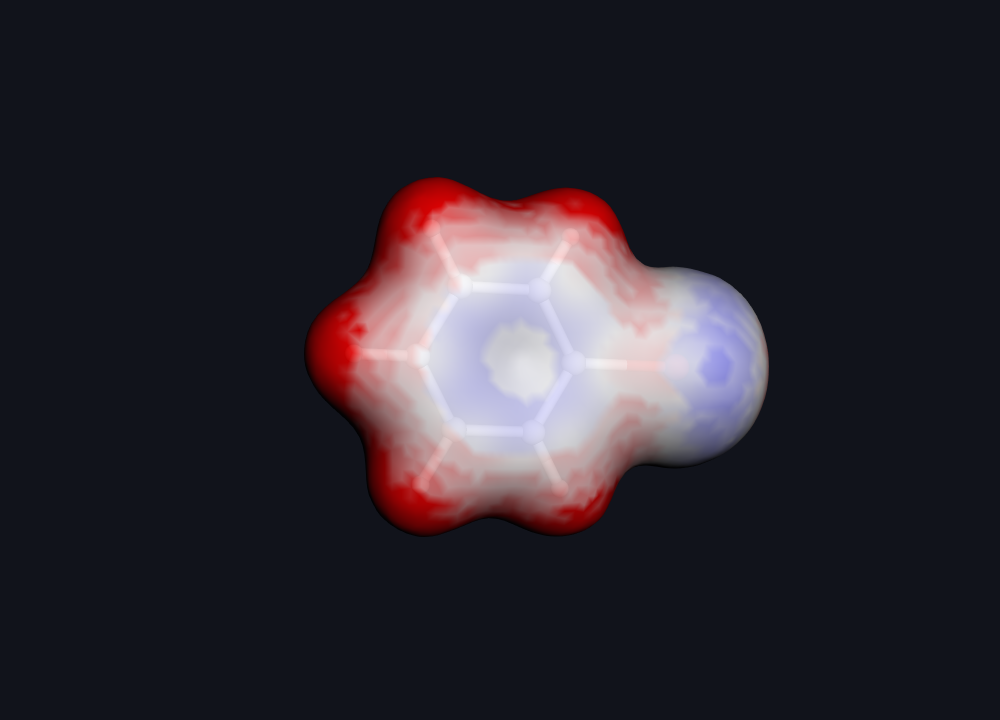
Hilbeon electrostatic-potential map of bromobenzene (RHF/def2-SVP). Red = negative (the ring edges and π-region); the blue cap on the bromine tip is the σ-hole — the positive patch that donates a halogen bond.
That is not a schematic. It is the real MEP Hilbeon evaluated on the molecular surface. The ring is awash in π-electron density (red), the bromine’s flanks are negative — and yet right on its tip, pointing away from the carbon, sits a blue cap. That cap is what reaches across a binding pocket and grabs a Lewis base.
Watching the σ-hole switch on: F < Cl < Br
The cleanest way to make the point is to walk down a column. We took the three halobenzenes — fluorobenzene, chlorobenzene, bromobenzene — and asked Hilbeon for the MEP at two places on each halogen: the tip (along the C–X axis, where the σ-hole lives) and the belt (perpendicular, where the lone pairs sit). The difference between them is the anisotropy — literally how lopsided the atom’s electrostatics are.
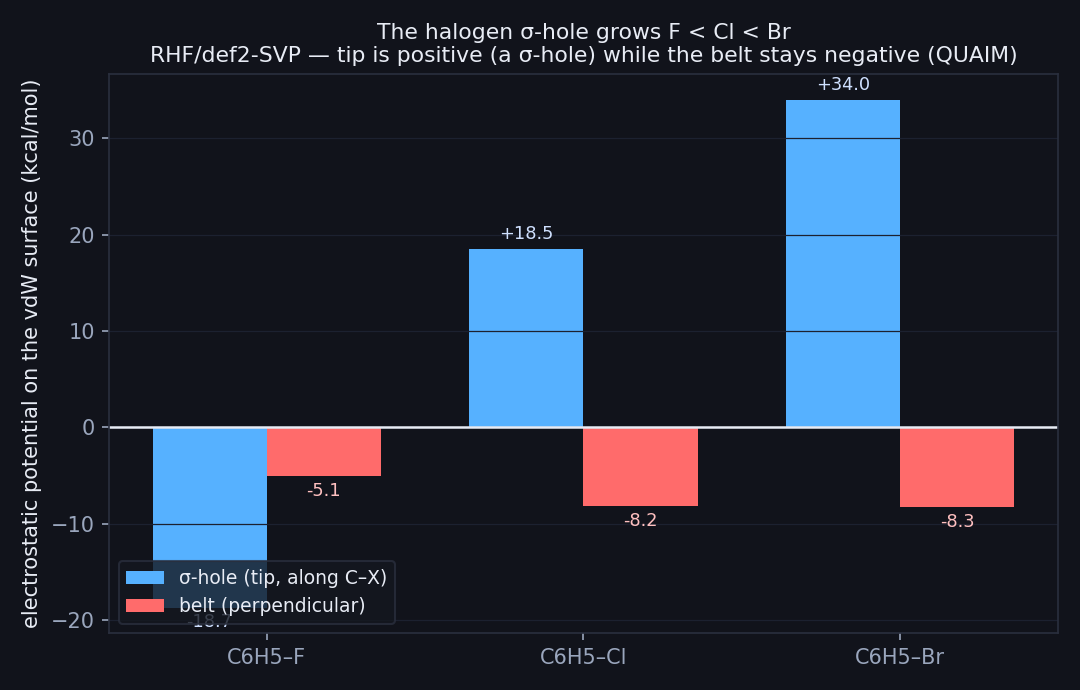
MEP at the halogen tip (σ-hole) vs the belt (perpendicular), RHF/def2-SVP. F has no σ-hole (tip negative); Cl and Br do, and it grows.
| Halogen (in C6H5–X) | σ-hole tip (kcal/mol) | Belt (kcal/mol) | Anisotropy (kcal/mol) |
|---|---|---|---|
| Fluorine | −18.7 | −5.1 | −13.6 |
| Chlorine | +18.5 | −8.2 | +26.7 |
| Bromine | +34.0 | −8.3 | +42.3 |
Read it top to bottom and the physics tells itself. Fluorine has no σ-hole at all: its tip is still negative (−18.7 kcal/mol), even more negative than its belt, so the anisotropy is the “wrong” way round (−13.6). Fluorine is small and ferociously electronegative; it simply does not give up enough density along the bond to expose a positive cap. Chlorine flips the sign — its tip is now +18.5 while the belt stays negative at −8.2, a clean positive-cap / negative-belt pattern. Bromine pushes it further still: the tip climbs to +34.0 and the anisotropy nearly doubles to +42.3. The σ-hole grows F < Cl < Br, in lockstep with how polarizable and how willing-to-donate each halogen is.
Map the σ-holes in your series
From a list of SMILES to a surface MEP and a tip-vs-belt table in a couple of prompts. See which of your halogens actually donate a bond.
Why it matters for drug design
A halogen bond is worth roughly the same energy as a moderate hydrogen bond, but it comes with two properties a medicinal chemist will pay for. The first is directionality: because the σ-hole is a small cap that points along the C–X axis, the interaction is geometrically demanding, and demanding interactions are selective — they fit one pocket and not its near neighbours. The second is that halogens are often already there on a scaffold, installed for metabolic or lipophilicity reasons, so a well-placed aryl chloride or bromide can convert an incidental atom into a genuine binding contact. This is established practice: halogen bonds have been engineered into kinase inhibitors and exploited across protein–ligand complexes precisely to dial in potency and selectivity.
The series also corrects a common misconception. Because fluorine is everywhere in drugs, it is tempting to reach for it as a halogen-bond donor — but the numbers say it is the one halogen that cannot do the job: no σ-hole, a negative tip, no bond to donate. Fluorine earns its ubiquity through entirely different effects — blocking metabolism, tuning pKa and conformation — which we explore in the metabolism and ionization posts. If you actually want a halogen bond, you reach for the heavier halogens: chlorine, bromine, and above all iodine, the favourite σ-hole donor in the field.
What these numbers are — and are not. Every value here is a RHF/def2-SVP single-point on an RDKit/MMFF geometry — the structures were not QM-reoptimized. The MEP is sampled on the van der Waals surface along the C–X axis, which approximates the standard VS,max read on the 0.001 a.u. isosurface; the absolute magnitudes therefore depend on the method, basis and surface convention. The robust, convention-independent conclusions are the two qualitative facts: the σ-hole grows F < Cl < Br, and each halogen is anisotropic — a positive tip over a negative belt. One honest gap: iodine, the strongest halogen-bond donor of all, needs an iodine basis/ECP that Hilbeon does not yet carry, so the series stops at bromine.
How to do it yourself
Everything above came from talking to the Hilbeon assistant in plain language — no input decks, no surface-grid syntax to memorize:
build bromobenzene from SMILES c1ccc(Br)cc1
run RHF/def2-SVP
compute the molecular electrostatic potential on the vdW surface
report the MEP at the bromine tip (along C-Br) and at its belt
render the ESP-mapped surface
repeat for chlorobenzene and fluorobenzene, then compare the tips
Prefer scripts? Each of those steps is also a call in Hilbeon’s MCP / HTTP API, so sweeping a halogenated library is a loop in a notebook. Hilbeon runs on its own integral engine (no third-party integral libraries), fully deterministic and reproducible to the last digit across machines — so the electrostatic potential you are reading is the real one, computed from the molecule’s own electron density.
The takeaway
The σ-hole dissolves the paradox: a halogen is not a uniform negative ball but an anisotropic atom with a positive cap on its tip and a negative belt around its waist. That cap is what donates a halogen bond, and it switches on and grows as you go down the column — absent in fluorine, real in chlorine, larger in bromine, and larger still (in principle) in iodine. For a designer it is a directional, selective contact hiding on atoms you may already have on the scaffold. Hilbeon reads it straight off the electron density and shows you exactly which of your halogens point a positive tip into the pocket — before you commit a synthesis to find out.
Map the σ-holes in your series
Start a 30-day guided pilot — every method, every core, your GPU — and see which halogens on your scaffold actually donate a bond.
References
- The σ-hole concept — T. Clark, M. Hennemann, J. S. Murray & P. Politzer, J. Mol. Model. 2007, 13, 291
- σ-hole bonding, a review — P. Politzer, J. S. Murray & T. Clark, Phys. Chem. Chem. Phys. 2013, 15, 11178
- Halogen bonding in drug design — M. R. Scholfield et al.; and S. Wilcken, M. O. Liu, M. C. Hendrich & F. M. Boeckler, J. Med. Chem. 2013, 56, 1363
- Molecular electrostatic potential & VS,max — overview
- The interaction Hilbeon also maps directly — Seeing Hydrogen Bonds with NCI