
Medicinal chemistry
Which Tautomer Does Your Assay Actually See?
Tautomers Implicit solvent SAR
The tautomer you drew on the whiteboard may not be the one your assay is binding. A tautomer swaps where a proton sits — and with it, which atoms are hydrogen-bond donors and which are acceptors. That is the exact information a binding pocket reads. Pick the wrong tautomer and your pharmacophore, your docking pose, and your SAR story can all be built on a form that barely exists in water. The catch: the favored tautomer often changes between the vacuum of a naive calculation and the aqueous buffer of a real assay.
You can see this coming with two calculations instead of a guess: optimize each tautomer, then add an implicit-solvent model for water. Hilbeon does both in one workflow. We ran it on two textbook cases that matter to drug hunters.
Case 1: 2-pyridone — the classic inversion
2-Hydroxypyridine (the hydroxy / lactim form) and 2-pyridone (the carbonyl / lactam form) are the canonical tautomer pair. Their equilibrium is famously environment-dependent: in the gas phase and non-polar solvents the hydroxy form is (slightly) preferred, while in water the pyridone dominates. It is a small, delicate balance in vacuum and a decisive one in solution.
We optimized both tautomers at B3LYP/6-31G(d), refined the energies with a def2-TZVP single point, and added Hilbeon's C-PCM implicit water. The result: in the gas phase the pair is nearly degenerate — our B3LYP number puts the pyridone a marginal 0.9 kcal/mol ahead — but adding water swings the balance by a further 4.7 kcal/mol toward the pyridone, to 5.7 kcal/mol. That is the difference between a genuine mixture and >99.9% pyridone. Whatever form you sketched, the aqueous assay sees the lactam.
An honest note on the gas-phase number. This near-degenerate pair is a known stress test for DFT: B3LYP marginally favors the pyridone in the gas phase, whereas higher-level methods (M06-2X, CCSD) favor the hydroxy form by 5–9 kJ/mol. The 1–2 kcal/mol scatter is right at the edge of the method. What is not in doubt — and what actually drives the biology — is the large, method-robust solvent shift toward the more polar lactam. That is the quantity worth trusting.
Case 2: 4-quinolone — why the antibiotics are drawn that way
Now a scaffold you have almost certainly prescribed or synthesized. The 4-quinolone core sits at the heart of the fluoroquinolone antibiotics (ciprofloxacin, levofloxacin) and the antimalarial 4-oxoquinolines. Its 4-oxo (keto) group and the adjacent N–H are not incidental — docking studies place them directly in the target contacts, so the keto tautomer is the pharmacophore.
The same protocol confirms it, and then some. 4-Quinolone (keto) beats 4-hydroxyquinoline (enol) by 5.0 kcal/mol already in the gas phase, and water widens the gap to 9.4 kcal/mol — an equilibrium that is, for all practical purposes, 100% keto. The form the medicinal chemist draws is exactly the form the water-bathed target meets. When the tautomer and the pharmacophore agree, that is worth confirming, not assuming.
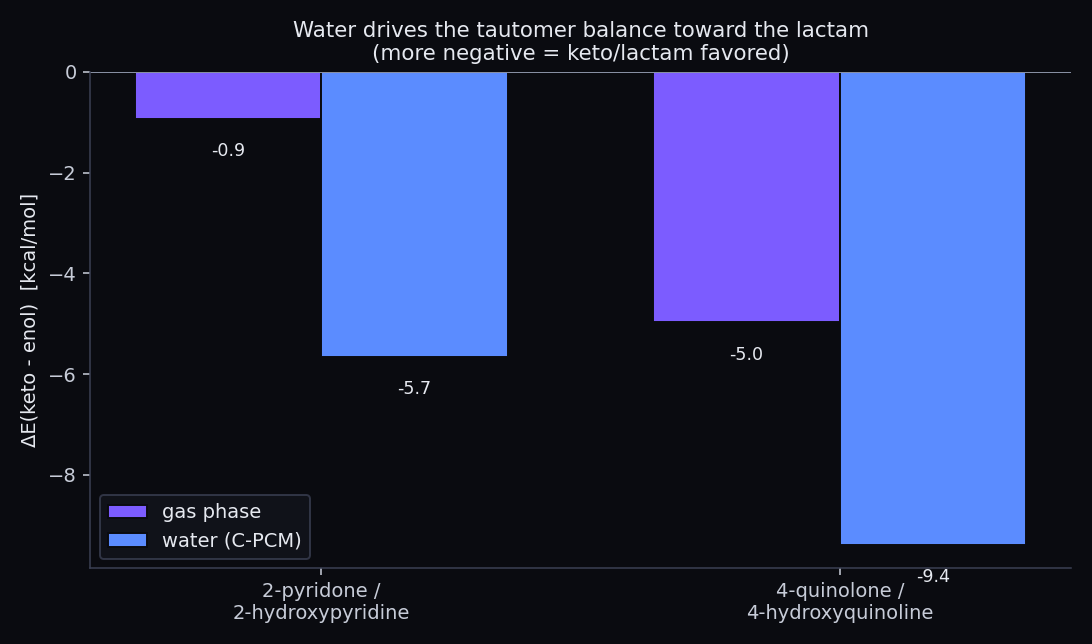
Relative tautomer energy ΔE(keto−enol) in gas vs implicit water (B3LYP/def2-TZVP//B3LYP/6-31G(d), C-PCM). More negative = lactam favored. Water deepens the lactam's advantage by ~4.4–4.7 kcal/mol in both systems. Gas-phase values are near-degenerate and method-sensitive (see note); the solvent shift is the robust result.
The receipts
| Tautomer pair (keto vs enol) | ΔE gas | ΔE water (C-PCM) | Solvent shift | Keto in water |
|---|---|---|---|---|
| 2-pyridone vs 2-hydroxypyridine | −0.9 kcal/mol | −5.7 kcal/mol | −4.7 kcal/mol | >99.9% |
| 4-quinolone vs 4-hydroxyquinoline | −5.0 kcal/mol | −9.4 kcal/mol | −4.4 kcal/mol | ≈100% |
Level: B3LYP/6-31G(d) gas-phase geometry optimization (both tautomers optimized to converged stationary points), def2-TZVP single-point energies, Hilbeon C-PCM water (ε = 78.4). Populations from ΔE by Boltzmann at 298 K; the ΔE columns are independently rounded from unrounded energies, so the solvent-shift column is not exactly the difference of the two rounded columns.
What this means for you: before you dock, fingerprint, or reason about SAR, decide the tautomer in the solvent your assay uses — not in vacuum, and not from the depiction in a database. A vacuum calculation would have called the pyridone case a coin-flip; the aqueous number calls it settled. One optimize-plus-solvent run per tautomer is cheap insurance against building a program on the wrong protonation pattern.
The workflow
Each number above came from the same three-step recipe, driven in plain language or a short script:
optimize 2-hydroxypyridine and 2-pyridone at B3LYP/6-31G(d)
refine both with a def2-TZVP single point
add C-PCM water and re-read the energies
compare: the lactam is 5.7 kcal/mol lower in water
No solvent cavity to hand-build, no separate reaction-field code — the implicit-water model rides along with the SCF, on the same hardware, in one command.
Honest edges
Three caveats, stated plainly. First, these are electronic energies with a continuum solvent (a ΔE-level comparison); we did not add vibrational free-energy corrections, which for isomeric tautomers are small and largely cancel in the shift that carries the story. Second, C-PCM is a continuum — it captures the bulk dielectric but not a specific first-shell water bridging the two heteroatoms, which is known to nudge these particular equilibria further; an explicit water or two is the next refinement. Third, as noted, the gas-phase pyridone balance is a hard, near-degenerate case where DFT scatters by ~1–2 kcal/mol. The robust deliverable is the direction and size of the solvent effect — and there, the calculation and the experiment agree.
Know the tautomer before you dock
Start a 30-day guided pilot — optimizer, implicit solvent and thermochemistry included — and settle your compound's tautomer in the solvent that matters.
References
- Gas-phase 2-hydroxypyridine / 2-pyridone equilibrium — Beak et al., J. Am. Chem. Soc. 10.1021/ja00786a078.
- Method dependence (B3LYP vs M06-2X / CCSD) — "The Thermodynamic and Kinetic Properties of 2-Hydroxypyridine/2-Pyridone Tautomerization", PMC5133892.
- Solvent and microsolvation effects — "Tautomerism and Microsolvation in 2-Hydroxypyridine/2-Pyridone", J. Phys. Chem. A 10.1021/jp104625z.
- 4-Quinolone / 4-hydroxyquinoline tautomerism and the 4-oxoquinoline pharmacophore — J. Org. Chem. 10.1021/acs.joc.5b02169.