
Application note
Where Will the Body Attack Your Molecule?
ADMET Reactivity Metabolism
Every drug that survives the body is, for a while, fighting it. Liver enzymes — above all the cytochrome P450 family — exist to grab onto foreign molecules and oxidize them into something the kidney can flush. Where they grab first is the molecule's site of metabolism (SOM), and it decides two things that make or break a compound: how long it lasts, and whether the oxidation product is harmless — or toxic.
You cannot see a site of metabolism with the naked eye, but you can reason about it from the electrons. CYP-mediated oxidation is, at heart, the enzyme pulling electron density out of your molecule. So the places where a molecule most readily gives up that density — its electron-rich, high-energy regions — are the places most exposed to attack. Two quantum-chemical pictures map exactly that: the frontier orbital (the HOMO, highest occupied molecular orbital) and the electrostatic potential (ESP). This post shows how to read them as a fast, first-principles sanity check on metabolic vulnerability — using a drug whose oxidation chemistry is one of the most consequential in all of pharmacology.
The frontier-orbital intuition
A molecule's HOMO is the highest-energy pool of electrons it owns. The shallower that pool — the higher the HOMO energy — the more easily an oxidant can lift an electron out of it. And the shape of the HOMO tells you not just whether a molecule is easy to oxidize, but where: the atoms carrying the largest orbital lobes are the ones presenting electron density to an approaching enzyme. Put the two together — a high HOMO energy plus large lobes on a particular ring or heteroatom — and you have a candidate soft spot to flag before any microsomal-stability assay is run.
Scope, stated up front. Frontier-orbital and ESP reasoning about sites of metabolism is qualitative insight, not a bench number. It complements — it does not replace — dedicated SOM and CYP regioselectivity models (which add the enzyme's own steric pocket and the catalytic cycle). Read what follows as a way to build chemical intuition quickly and cheaply, then confirm with a purpose-built predictor or experiment.
The star example: paracetamol and NAPQI
Paracetamol (acetaminophen, C₈H₉NO₂) is the textbook case of why the site of metabolism matters. At normal doses most of it is conjugated and excreted harmlessly. But a fraction is oxidized by CYP enzymes on its electron-rich phenol ring to a reactive quinone-imine called NAPQI — N-acetyl-p-benzoquinone imine. NAPQI is normally mopped up by glutathione; in overdose the glutathione runs out, NAPQI binds liver proteins, and the result is the acute hepatotoxicity that makes paracetamol overdose a leading cause of acute liver failure. The whole drama hinges on one oxidation site — and that site is exactly where the frontier orbital lives.
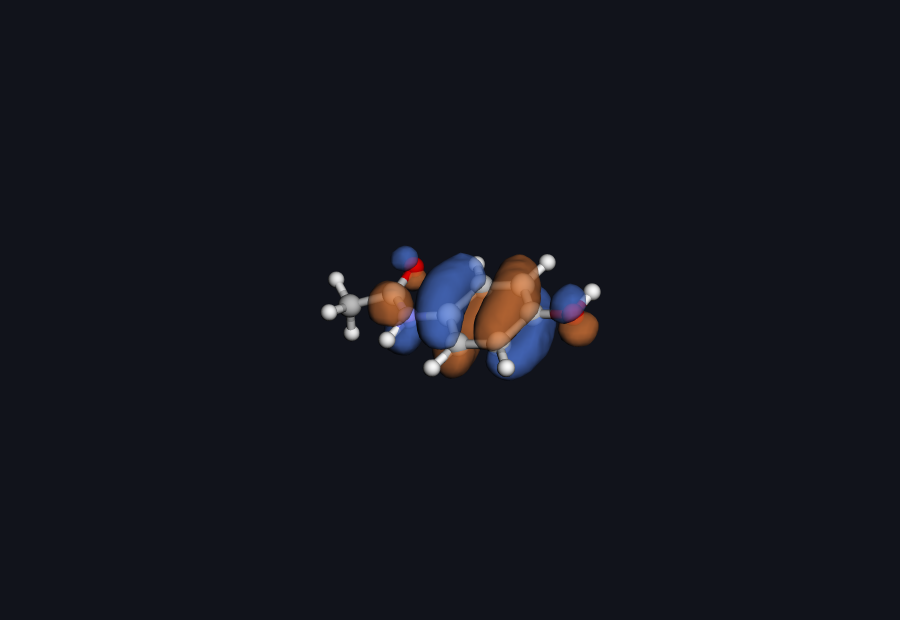 Paracetamol HOMO — real Hilbeon cube (drag to rotate)
Figure: the paracetamol HOMO computed by Hilbeon (B3LYP/6-31G(d) on the QM-optimized geometry, cube file). The orbital piles up on the electron-rich phenol ring and its oxygen — the same ring CYP oxidizes to NAPQI. Blue and orange lobes are the two signs of the wavefunction.
That is a real Hilbeon orbital, not a cartoon: rendered from a cube file that Hilbeon wrote from the actual wavefunction. And it is doing precisely what the metabolism textbook predicts — the density that the enzyme will attack sits on the phenol ring. Frontier-orbital reasoning would have pointed a chemist at the right ring before knowing anything about NAPQI.
Numbers: paracetamol is easier to oxidize than aspirin
Intuition is good; a comparison is better. Run the same calculation on aspirin and paracetamol and the HOMO energies separate cleanly. Paracetamol's HOMO sits higher (less tightly bound), which makes it the easier electron donor — the easier target for oxidative metabolism.
| Molecule | HOMO energy (B3LYP/6-31G(d)) | Read on oxidation |
|---|---|---|
| Paracetamol (C₈H₉NO₂) | −5.376 eV | Higher HOMO → easier to oxidize (CYP → NAPQI on the phenol ring) |
| Aspirin (C₉H₈O₄) | −6.819 eV | Lower HOMO → harder to oxidize; cleared mainly by ester hydrolysis instead |
The 1.44 eV gap between the two HOMOs is the electronic restatement of a clinical fact: paracetamol has an oxidative liability that aspirin largely does not. Aspirin's main clearance route is a different soft spot entirely — its ester bond is cleaved by esterases and water to give salicylic acid, so it is attacked by hydrolysis, not oxidation. The same engine, pointed at two molecules, separates two distinct metabolic fates — and tells you which kind of soft spot each one has. (We took aspirin apart in detail in A Computational Portrait of Aspirin.)
Find your compound's soft spot
From a SMILES string to a frontier-orbital cube in a couple of prompts. See where your molecule is electronically exposed.
ESP: the electrostatic half of the story
The HOMO tells you where electron density is loosely held; the electrostatic potential tells you where the surface is electron-rich enough to invite attack and where a metabolite or conjugate might dock. On aspirin, Hilbeon's ESP-fitted charges (Merz–Kollman) put the most negative potential on the carboxyl oxygens — the C=O oxygen at −0.605 and the hydroxyl oxygen at −0.652 — with the acetyl carbonyl oxygen close behind at −0.587. The most positive site is the acidic carboxylic O–H proton at +0.46. Those electron-rich oxygens are the hydrogen-bond acceptors a metabolizing enzyme's active site has to recognize before it can do anything; reading ESP and HOMO together is how you reason about both recognition and reaction.
What these pictures are for. The HOMO and ESP here are insight and visualization — they sharpen chemical intuition about reactivity and recognition. They are not bench-matched single values, and they are not a CYP regioselectivity prediction on their own. Level of theory throughout: B3LYP/6-31G(d) on QM-optimized geometries (RDKit ETKDG+MMFF starting structures, then geometry-optimized by Hilbeon).
How to do it yourself
Every picture above came from talking to the Hilbeon assistant in plain language — no input decks, no basis-set syntax to memorize:
build paracetamol from SMILES CC(=O)Nc1ccc(O)cc1
run RHF/6-31G(d)
report the HOMO energy
render the HOMO cube
build aspirin from SMILES CC(=O)OC1=CC=CC=C1C(=O)O and compare HOMO energies
Prefer scripts? Every one of those steps is also a call in Hilbeon's MCP / HTTP API, so the comparison is reproducible end-to-end in a notebook or a CI job. Hilbeon runs on its own GPU-accelerated integral engine (McMurchie–Davidson + Rys — no third-party libraries), fully deterministic and reproducible to the last digit across machines, so the electrons you are reasoning about are the real ones.
The takeaway
The body attacks molecules where their electrons are easiest to take. Frontier orbitals and ESP make that vulnerability visible from first principles, in minutes, before a single assay. Paracetamol's HOMO sits high and pools on the phenol ring — the exact site CYP oxidizes to hepatotoxic NAPQI — while aspirin's deeper HOMO leaves it to be hydrolyzed at the ester instead. Two molecules, two soft spots, one engine. Use it as a fast intuition layer; confirm the regiochemistry with a dedicated SOM model. Then point the same engine at your compound and find its soft spot first.
Run your own molecule
Start a 30-day guided pilot — every method, every core, your GPU — and find the metabolic soft spot of the compound on your bench.
References
- Site-of-metabolism prediction — SMARTCyp (Bioinformatics)
- NAPQI & paracetamol metabolism — Paracetamol (Wikipedia)
- Aspirin, in depth — A Computational Portrait of Aspirin